-
Interactive DashboardsCreate interactive BI dashboards with dynamic visuals.
-
End-User BI ReportsCreate and deploy enterprise BI reports for use in any vertical.
-
Wyn AlertsSet up always-on threshold notifications and alerts.
-
Localization SupportChange titles, labels, text explanations, and more.
-
Wyn ArchitectureA lightweight server offers flexible deployment.
-
 Wyn Enterprise 7.1 is ReleasedThis release emphasizes Wyn document embedding and enhanced analytical express...
 -
 Choosing an Embedded BI Solution for SaaS ProvidersAdding BI features to your applications will improve your products, better serve your customers, and more. But where to start? In this guide, we discuss the many options.
-
Visual GalleryInteractive sample dashboards and reports.
-
BlogExplore Wyn, BI trends, and more.
-
WebinarsDiscover live and on-demand webinars.
-
Customer SuccessVisualize operational efficiency and streamline manufacturing processes.
-
Knowledge BaseGet quick answers with articles and guides.
-
VideosVideo tutorials, trends and best practices.
-
WhitepapersDetailed reports on the latest trends in BI.
-
 Choosing an Embedded BI Solution for SaaS ProvidersAdding BI features to your applications will impr...
 -

- Getting Started
- Administration Guide
-
User Guide
- An Introduction to Wyn Enterprise
- Document Portal for End Users
- Data Governance and Modeling
- View and Manage Documents
- Working with Resources
- Working with Reports
- Working with Dashboards
- Working with Notebooks
- Wyn Analytical Expressions
- Section 508 Compliance
- Subscribe to RSS Feed for Wyn Builds Site
- Developer Guide
Dashboard Variants

Dashboard variants allow you to create and save alternate views of an existing dashboard directly from the dashboard lite viewer. Variants are useful when you want to analyze the same dashboard from different perspectives without modifying the original design or creating multiple dashboard files.
You can adjust the view by applying slicers, filtering or sorting scenarios, changing data bindings, or applying conditional formatting. When the dashboard reflects the view you want to preserve, you can save it as a variant and return to it at any time.
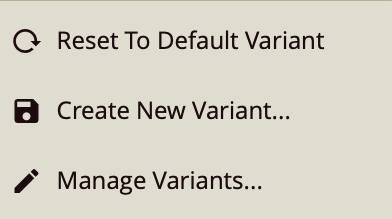
Create a Variant
Use these steps to save the current dashboard view as a variant.
Modify the dashboard to the view you want to save.
You can apply changes such as:
Slicer filters that affect all scenarios.
Scenario-level filtering or sorting.
Conditional formatting.
Adjustments to scenario data binding.
On the dashboard lite ribbon, select Variant.
Select Create New Variant….
Enter a name for the variant, and then select OK.
The variant is added to the Variant list.
You can repeat these steps to create additional variants. Each variant appears in the Variant dropdown and can be selected at any time.
Reset to the Default Dashboard
You can return to the original view of the dashboard—the version created in the designer—by resetting the variant.
On the dashboard lite ribbon, select Variant.
Select Reset to Default Variant.
The dashboard reverts to its original, unmodified state.
Manage Variants
Use the Manage Variants window to view or remove existing variants.
On the dashboard lite ribbon, select Variant.
Select Manage Variants….
A window opens with a list of all saved variants.
To remove a variant, select the trash-can icon next to it.
The variant is removed from the list and no longer appears in the Variant dropdown.