-
Interactive DashboardsCreate interactive BI dashboards with dynamic visuals.
-
End-User BI ReportsCreate and deploy enterprise BI reports for use in any vertical.
-
Wyn AlertsSet up always-on threshold notifications and alerts.
-
Localization SupportChange titles, labels, text explanations, and more.
-
Wyn ArchitectureA lightweight server offers flexible deployment.
-
 Wyn Enterprise 7.1 is ReleasedThis release emphasizes Wyn document embedding and enhanced analytical express...
 -
 Choosing an Embedded BI Solution for SaaS ProvidersAdding BI features to your applications will improve your products, better serve your customers, and more. But where to start? In this guide, we discuss the many options.
-
Visual GalleryInteractive sample dashboards and reports.
-
BlogExplore Wyn, BI trends, and more.
-
WebinarsDiscover live and on-demand webinars.
-
Customer SuccessVisualize operational efficiency and streamline manufacturing processes.
-
Knowledge BaseGet quick answers with articles and guides.
-
VideosVideo tutorials, trends and best practices.
-
WhitepapersDetailed reports on the latest trends in BI.
-
 Choosing an Embedded BI Solution for SaaS ProvidersAdding BI features to your applications will impr...
 -

- Getting Started
- Administration Guide
-
User Guide
- An Introduction to Wyn Enterprise
- Document Portal for End Users
- Data Governance and Modeling
-
View and Manage Documents
- View Documents
- Duplicate a Document
- Delete a Document
- Rename a Document
- Copy URL
- Hide a Document
- Share a Document
- Document Binder
-
Schedule a Task
- Report Bursting
- Task Delegation
- Document Binding
- Create a Scheduled Task to Run a Report
- Create a Scheduled Task to Run a Dashboard
- Create a Scheduled Task to Run a Datasource
- Create a Scheduled Task to Run a Dataset
- Create a Scheduled Task to Run a Data Model
- Create a Scheduled Task to Print a Report
- Create a Scheduled Task to Cache a Report
- Create a Scheduled Task on a SharePoint Site
- Enable Report Caching
- Restore Deleted Documents
- Monitor Data with Alerts
- Advanced Filter Settings
- Working with Resources
- Working with Reports
- Working with Dashboards
- Working with Notebooks
- Wyn Analytical Expressions
- Section 508 Compliance
- Subscribe to RSS Feed for Wyn Builds Site
- Developer Guide
Create a Scheduled Task on a SharePoint Site
Wyn Enterprise allows automated report generation through scheduled tasks. These tasks can generate documents at predefined times or intervals and deliver them to external storage systems such as AWS S3, FTP, SFTP, and SharePoint. In scenarios where a customer needs to store scheduled-task output directly on a SharePoint Online site, Wyn Enterprise can integrate with SharePoint using Microsoft Graph API and Azure AD client credential authentication.
To Schedule a Task in SharePoint Online Mode
This section describes how to set up a report that automatically generates regularly, like daily, weekly, monthly, or yearly.
Note: For successful task execution, make sure that the report worker service is running in the background, the scheduled task will fail to execute. To get the status of the report worker service, navigate to the Node Management page on the Admin Portal.
On the Document Portal, select the report you want to schedule.
With the report selected, click the Info button in the top-right corner of the portal.
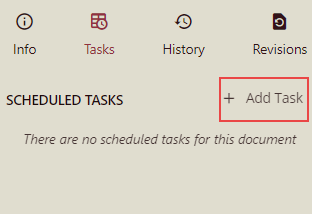
In the Info panel that appears, navigate to the Tasks tab and click the + Add Task button to create a new scheduled task.
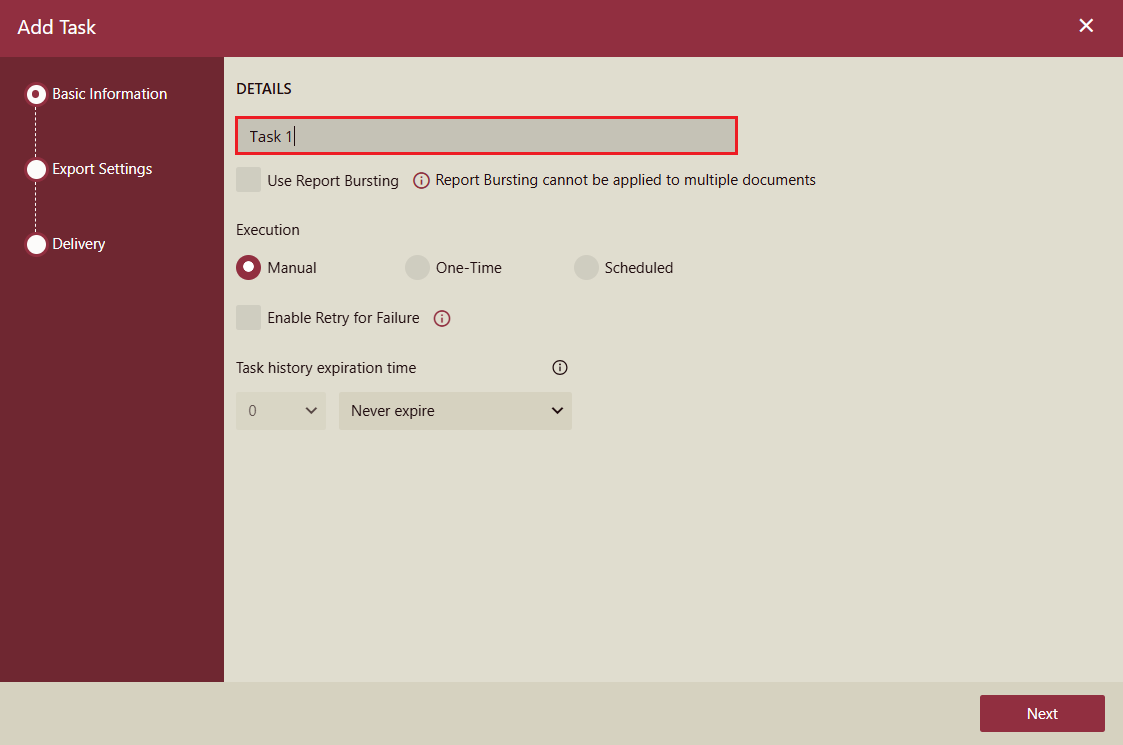
Enter the task description in the Details field.
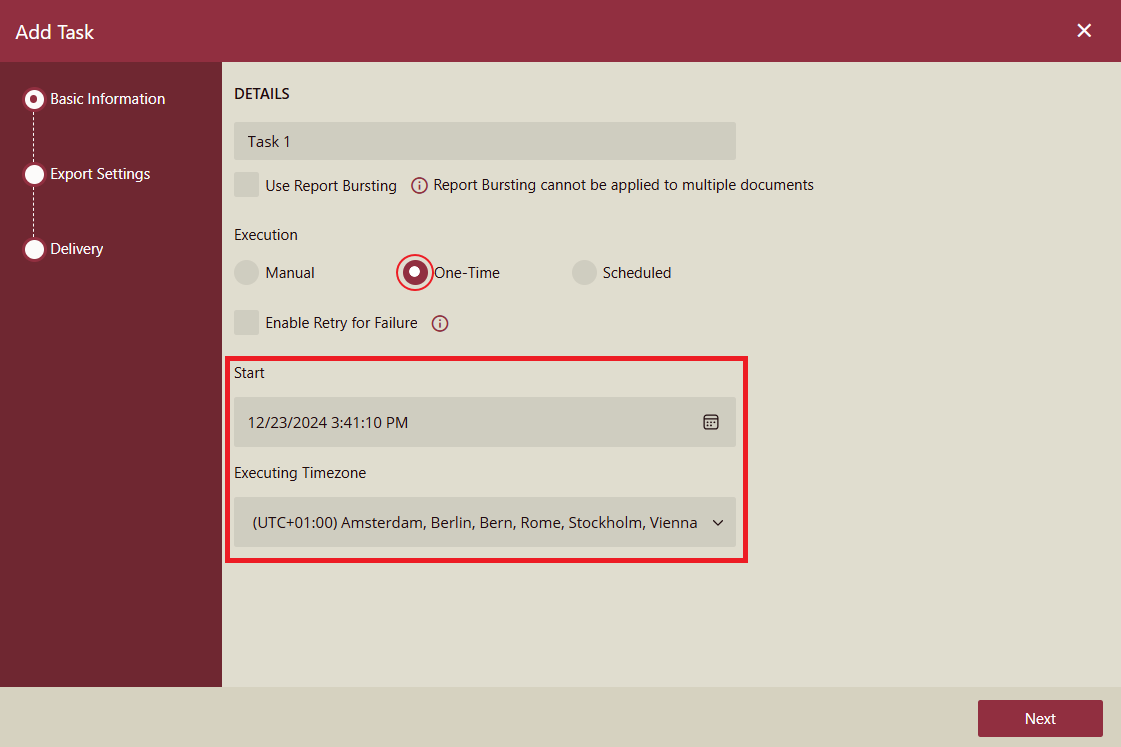
By default, tasks are manually scheduled in Wyn Enterprise. If the Execution field is set to One-Time, then you can specify the Start date-time and Executing Timezone as per your requirement.
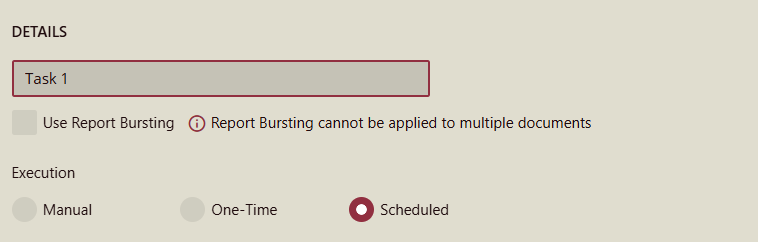
To create a task that runs at fixed intervals of time, set the Execution field to 'Scheduled'.
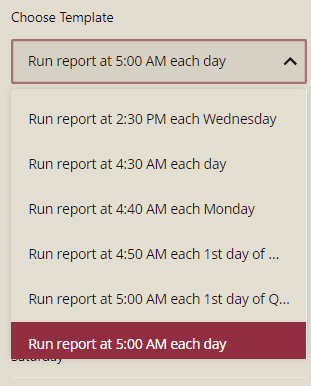
From the Choose Template dropdown, select a suitable schedule template that matches your requirements. The list shows both the built-in and custom templates on the server. For more information on how to create a custom schedule template, visit this article.
The Start and the End fields pick the default values specified in the chosen schedule template. These default values are unchangeable.
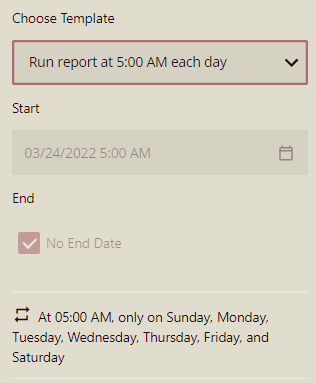
Note: If the chosen template has predefined settings for the export format or delivery method, then their corresponding fields, like Export Format and Delivery Method, are set to default values as specified in the template, and hence can't be modified.
Add Execution Time Range option allows specifying a time range for daily recurring tasks within which the task should only execute. To select the time range:
Select Daily for REPEAT and select Every hour(s) for the execution time.
The Add Execution Time Range check box will appear.
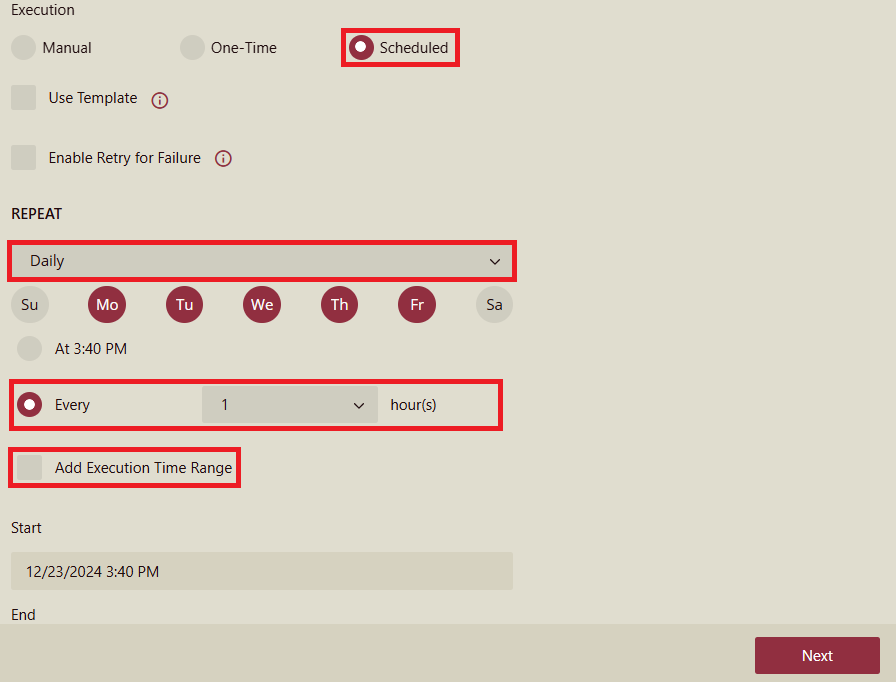
Select Add Execution Time Range, and the Start Time and End Time selectors will appear to select the time range during which the task is executed in a day.
The default value of Start Time is "12:00 AM".
The default value of End Time is "11:59 PM"
After adding the execution time range, the description of the execution time range will be displayed in the task description.
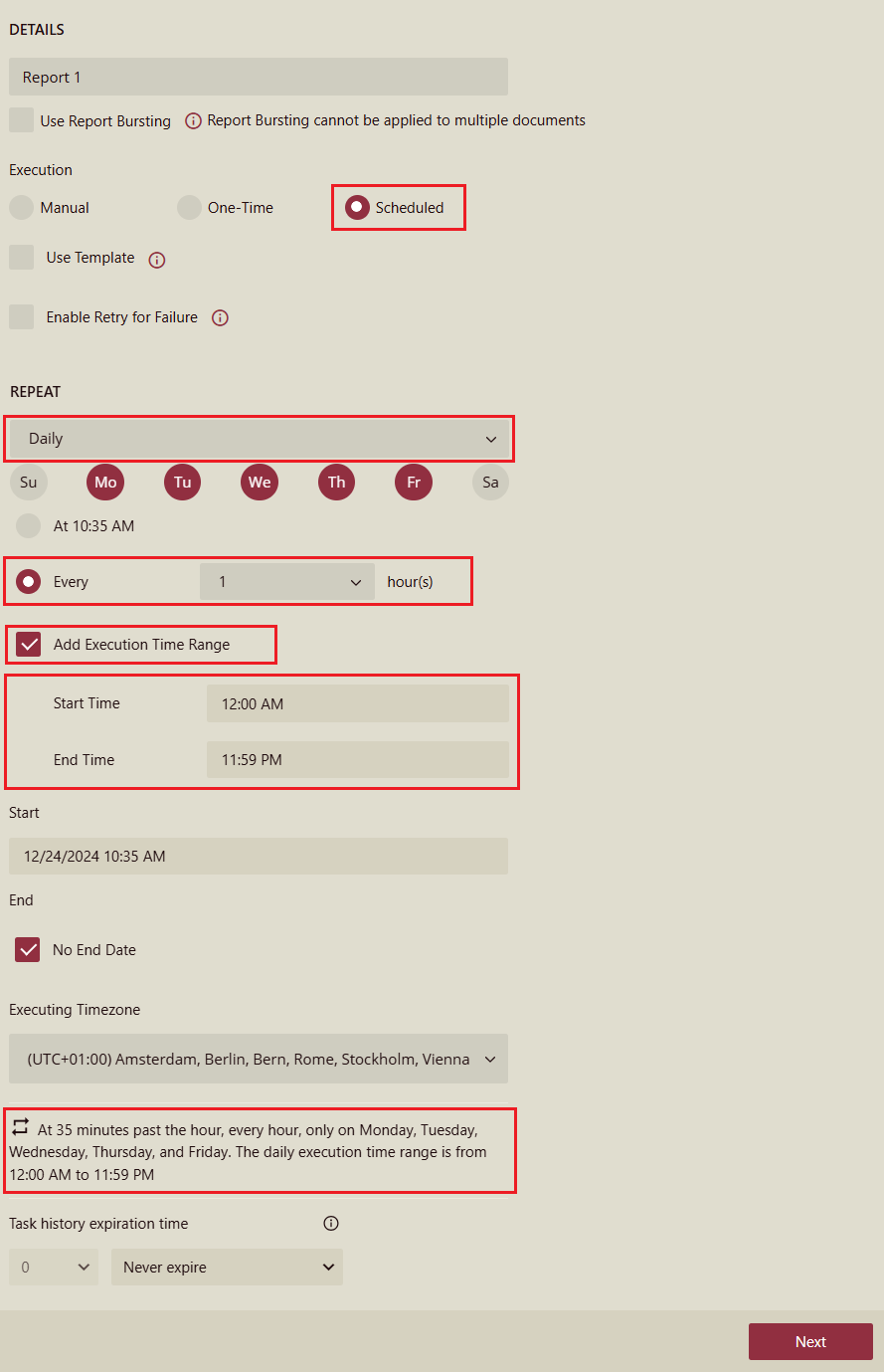
There are two ways to modify the Start Time and End Time:
Selection box
Input text
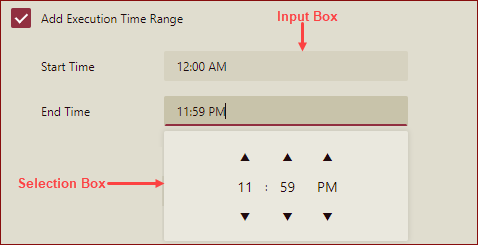
The Start Time and End Time must have a value.
Please note the following for Add Execution Time Range:
When the start time and end time are set incorrectly, the Create Task button cannot be clicked. Requirements for correct execution time range setting:
The start time and end time cannot be empty.
The time should be correct, and the format is "hh: mm AM”.
The start time must be earlier than the end time.
If there is an Execution Time Range in the task template, when creating the task using this template, the Execution Time Range information of the template will be displayed in the description of the task. The description is the same as the description of the Execution Time Range on the daily schedule task.
When creating tasks for reports and creating schedule templates, if the user selects REPEAT as Daily, the user is allowed to add the Execution Time Range on the day.
If the export format settings are not defined in the schedule template, then specify how to store or share the report result through the options available in the Export Format dropdown. The supported formats are PDF, Excel, Word, CSV, HTML, Image, JSON, TXT, XML, and Excel Data, or create custom export templates based on your requirements.
You can check the Advanced Settings option to specify the advanced export properties for the chosen format.
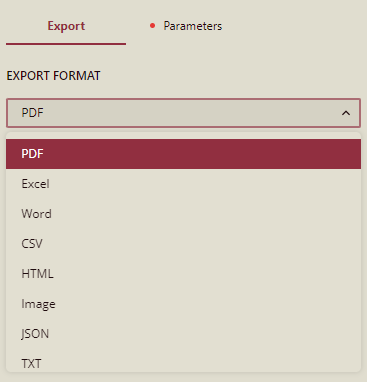
In case your report contains any parameter(s) or variant(s), you need to enter valid parameter value(s) or set the report variant. Otherwise, a message saying 'Invalid Parameters' will be displayed.
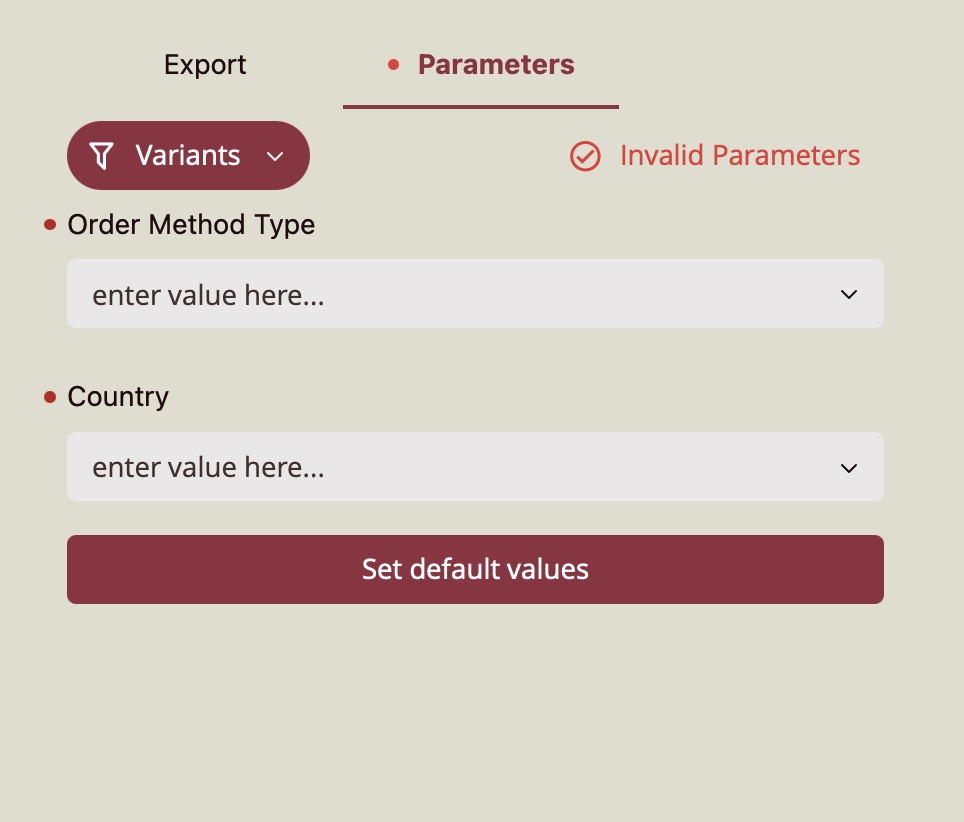
Click on the Variants button to select your variant.
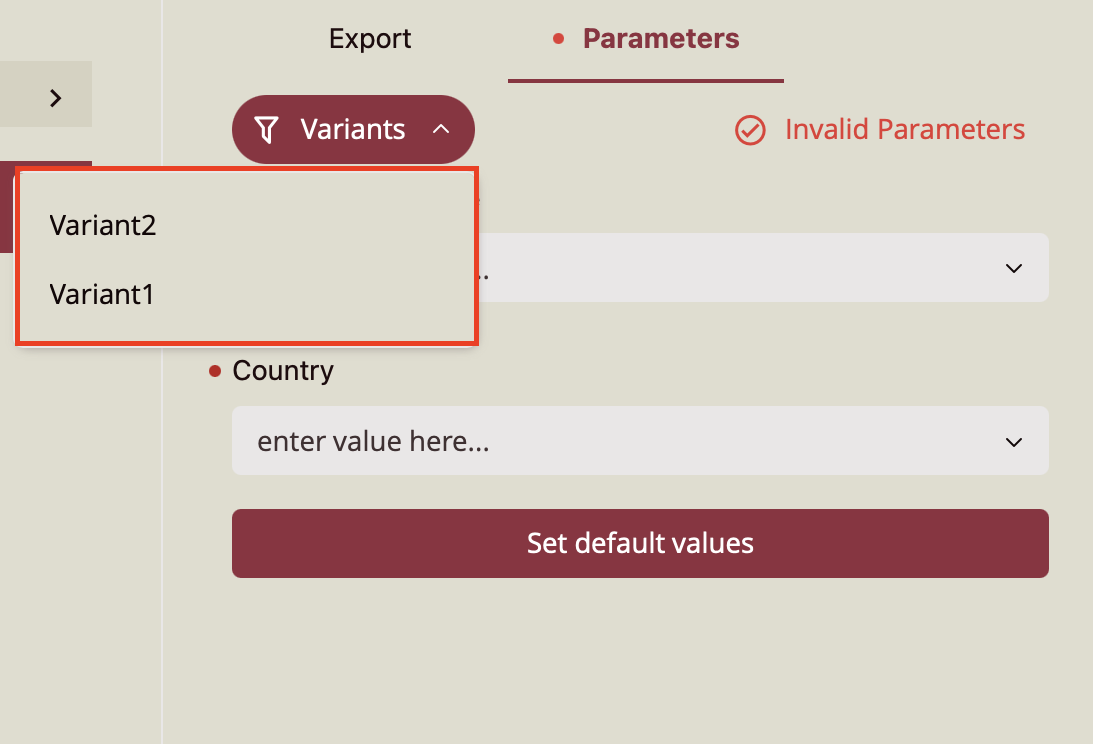
It will auto-populate the parameter values. If you want to delete the values you entered, click Set default values.
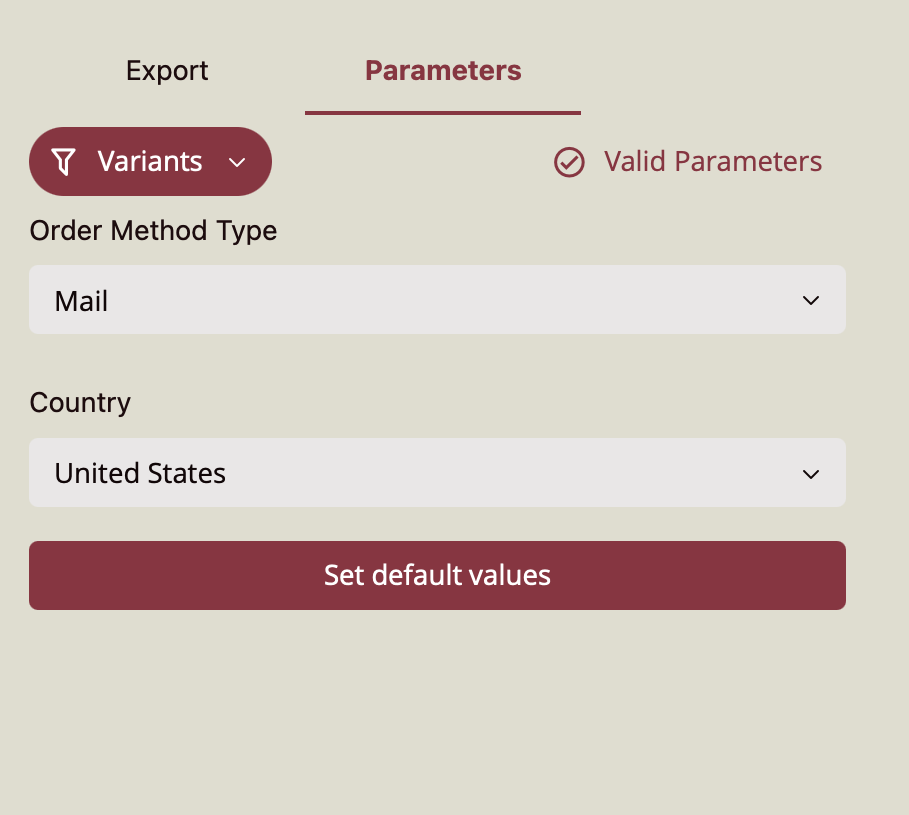
Note: If the filter is updated/modified, the new settings of the filter will be displayed for the subsequent scheduled task executions.
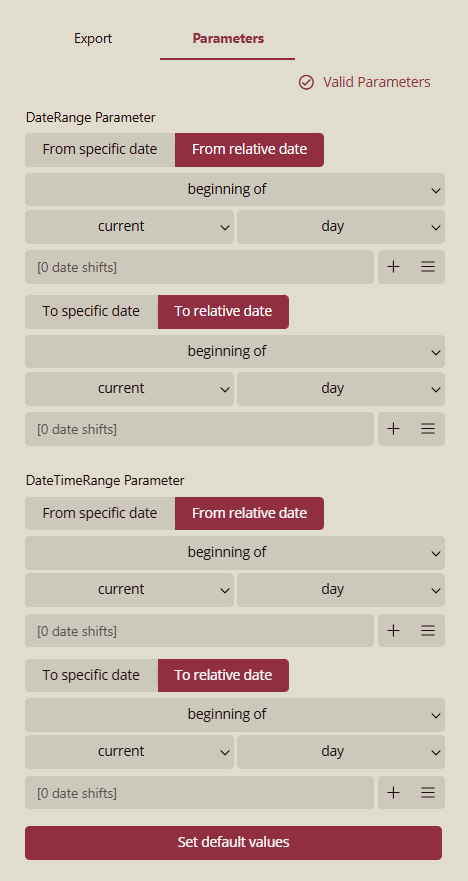
If you have used the Date Range/DateTime Range Editors to set the parameters in the custom parameter view, then you can set the Specific Date/DateTime range and Relative Date/DateTime range for the reports while creating a scheduled task. Refer to the example below for details.
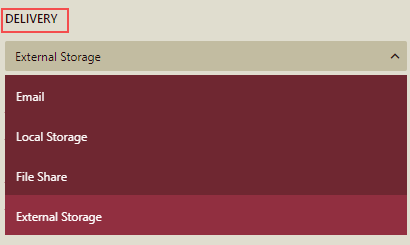
If the delivery method is not specified in the schedule template, then select an appropriate method like email, local storage, file share, external storage, or application message from the Delivery dropdown, and set its corresponding fields.
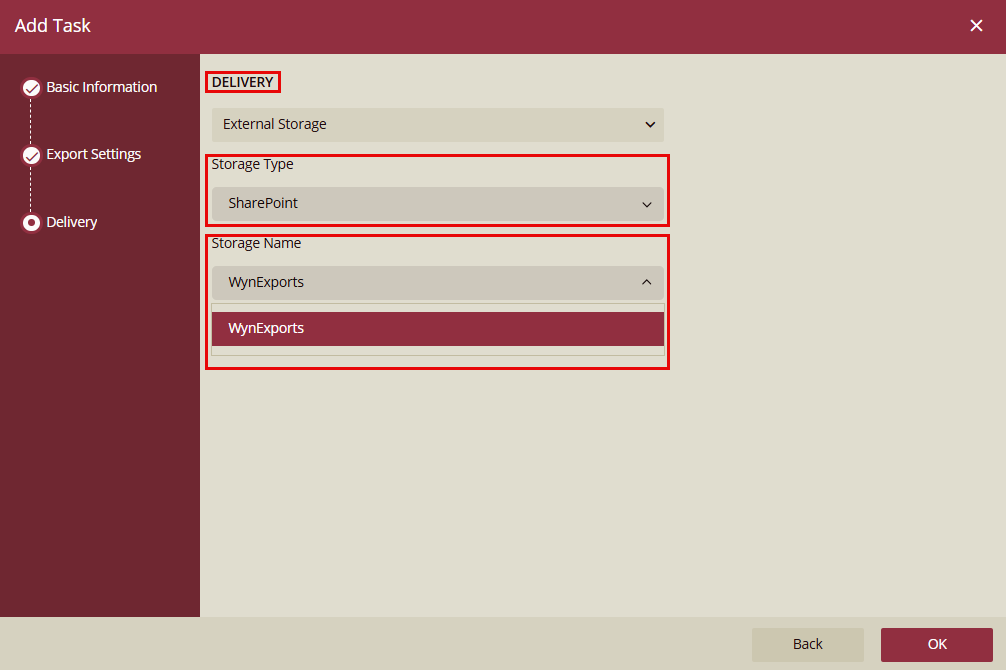
Choose SharePoint as the Storage Type and specify the Storage Name, in this case WynExports.
Click the OK button to save the settings. Note that the newly created task is listed under the Scheduled Tasks section and exported to the SharePoint Site.
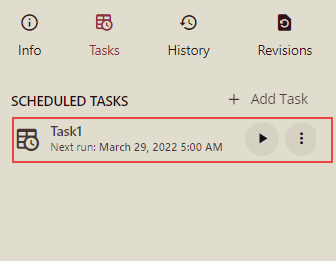
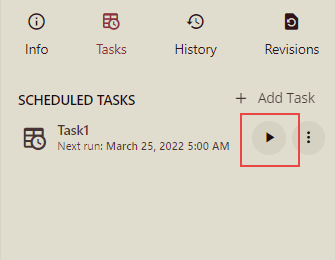
Click the Run Task button to execute the scheduled task manually out of the recurring iteration whenever you want, or to check whether a scheduled task runs correctly with the applied settings.
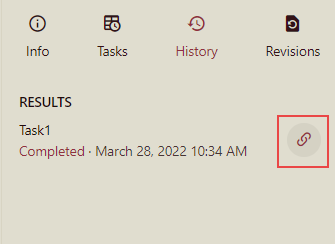
From the Task History tab, you can check whether the scheduled task is completed or failed. If the scheduled task completes its execution, click the Download link to store the report result on your system.
Example
Setting "From relative date", "To relative date" when the DateRange editor and DateTimeRange editor are used to set the parameters.
In this example, we have used the DateRange and DateTimeRange editors to set the parameters. On the Add Task screen, we have selected the From relative date and To relative date as shown below.
Add date shift by day, week, month, and year. Add date shift functionality consists of enhancing date controls for more complex scheduling, allowing tasks to be set on specific days relative to the current date. In this case, we used the day and shifted the days as shown in the image below:
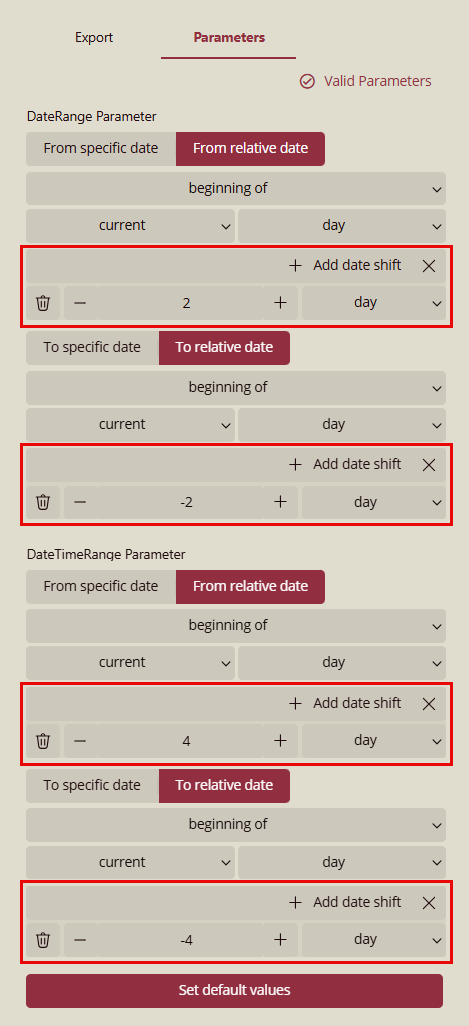
Once the task is added, run the task and view the result. The data will be displayed as per the relative date range set while creating the scheduled task.
To Manage a Scheduled Task
To manage a scheduled task, click the Actions button  in the Tasks tab. You can use this button to disable, edit, duplicate, or delete a scheduled task.
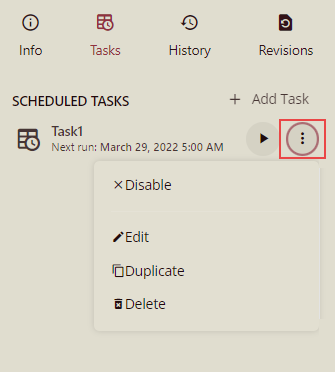
Disable - Deactivates all the future scheduled executions for that task. You can resume the task execution once you enable the scheduled task by clicking the Actions button.
Edit - Enables you to modify the existing information for that task, like its name, execution type, timings, export format, and so on.
Duplicate - Creates a new task with all the settings defined the same as in the originally scheduled task. This way, you can reuse the settings and save your time and effort in recreating a scheduled task from scratch.
Delete - Discards the scheduled task. Note that once you delete a scheduled task, it is gone forever.
Task Execution Modes
The section below describes the fields available for the different task execution modes supported in Wyn Enterprise: manual, one-time, and scheduled.
Manual Task Execution Mode
For the manual execution mode, you need to specify the following fields in the task dialog.
Property | Description |
|---|---|
Details | Enter a description for the task. |
Execution | Choose the execution mode for the task. In this case, set it to 'Manual'. |
Export Format | Specify in what format you want to share or store the result. The supported formats are PDF, Excel, Word, CSV, HTML, Image, JSON, TXT, XML, and Excel Data. You can also create a customized export template based on your requirements. For more information, see the Export Templates article. After selecting the export format, you can check the Advanced Settings option to define the advanced export properties for the chosen file format. |
Parameters/Filters | Input valid parameter value(s) for the report, if any. In case there are any saved filter(s), you can select the filter(s). If there are no saved filters, then the Filter option is not displayed. Refer to Preview a Report for saving the filters. |
Delivery | • External Storage - This is the only method available for delivering generated documents. You can choose the storage type and specify the storage name to send the results to a target location. Access to the created external storage is restricted to users with the appropriate roles and organizations, as determined by Admin permissions set during storage configuration. |
One-Time Task Execution Mode
For the one-time execution mode, you need to specify the following fields in the task dialog.
Property | Description |
|---|---|
Details | Enter a description for the task. |
Execution | Choose the execution mode for the task. In this case, set it to 'One-Time'. |
Start | Set the start date and time for the task. The start time can't be set to any time less than 5 minutes from the current time. |
Export Format | Specify in what format you want to share or store the result. The supported formats are PDF, Excel, Word, CSV, HTML, Image, JSON, TXT, XML, and Excel Data, or create customized export templates based on your requirements. See this article for more information on export templates. Check the Advanced Settings option to define advanced export properties for the chosen file format. |
Parameters/Filters | Input valid parameter value(s) for the report, if any. In case there are any saved filter(s), you can select the filter(s). If there are no saved filters, then the Filter option is not displayed. Refer to Preview a Report for saving the filters. |
Delivery | • External Storage - This is the only method available for delivering generated documents. You can choose the storage type and specify the storage name to send the results to a target location. Access to the created external storage is restricted to users with the appropriate roles and organizations, as determined by Admin permissions set during storage configuration. |
Scheduled Task Execution Mode
For the scheduled execution mode, you need to specify the following fields in the task dialog.
Property | Description |
|---|---|
Details | Enter a description for the task. |
Execution | Choose the execution mode for the task. In this case, set it to 'Scheduled'. |
Choose Template | Select a schedule template for the task. A schedule template is used to define the recurring interval at which to run a report, the delivery method, and the export format. See this article for more information on schedule templates. |
Export Format | Specify in what format you want to share or store the result. The supported formats are PDF, Excel, Word, CSV, HTML, Image, JSON, TXT, XML, and Excel Data, or create customized export templates based on your requirements. See this article for more information on export templates. Check the Advanced Settings option to define advanced export properties for the chosen file format. |
Parameters/Filters | Input valid parameter value(s) for the report, if any. In case there are any saved filter(s), you can select the filter(s). If there are no saved filters, then the Filter option is not displayed. Refer to the Preview Report for saving the filters. |
Delivery | • External Storage - This is the only method available for delivering generated documents. You can choose the storage type and specify the storage name to send the results to a target location. Access to the created external storage is restricted to users with the appropriate roles and organizations, as determined by Admin permissions set during storage configuration. |