-
Interactive DashboardsCreate interactive BI dashboards with dynamic visuals.
-
End-User BI ReportsCreate and deploy enterprise BI reports for use in any vertical.
-
Wyn AlertsSet up always-on threshold notifications and alerts.
-
Localization SupportChange titles, labels, text explanations, and more.
-
Wyn ArchitectureA lightweight server offers flexible deployment.
-
 Wyn Enterprise 7.1 is ReleasedThis release emphasizes Wyn document embedding and enhanced analytical express...
 -
 Choosing an Embedded BI Solution for SaaS ProvidersAdding BI features to your applications will improve your products, better serve your customers, and more. But where to start? In this guide, we discuss the many options.
-
Visual GalleryInteractive sample dashboards and reports.
-
BlogExplore Wyn, BI trends, and more.
-
WebinarsDiscover live and on-demand webinars.
-
Customer SuccessVisualize operational efficiency and streamline manufacturing processes.
-
Knowledge BaseGet quick answers with articles and guides.
-
VideosVideo tutorials, trends and best practices.
-
WhitepapersDetailed reports on the latest trends in BI.
-
 Choosing an Embedded BI Solution for SaaS ProvidersAdding BI features to your applications will impr...
 -

- Getting Started
- Administration Guide
-
User Guide
- An Introduction to Wyn Enterprise
- Document Portal for End Users
- Data Governance and Modeling
- View and Manage Documents
- Working with Resources
- Working with Reports
-
Working with Dashboards
- Tour the Dashboard Designer
- Create a Dashboard
- Configure Dashboard
-
Dashboard Data Binding
- Data Attributes
- Scenarios
- Appearance
- Component Management
- Parameters
- Interactions
- Finalize Your Dashboard
- Using AI in Wyn
- Working with Notebooks
- Wyn Analytical Expressions
- Section 508 Compliance
- Subscribe to RSS Feed for Wyn Builds Site
- Developer Guide
Ranking Calculation
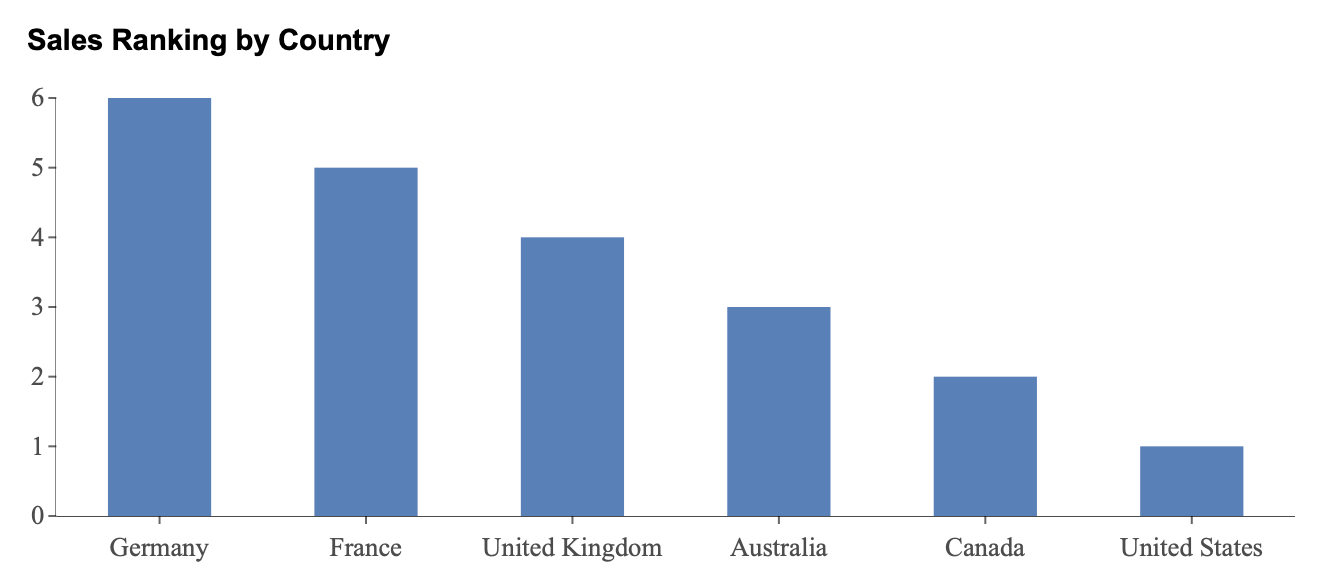
Ranking calculations transform numeric values into their relative positions within a dataset. Instead of displaying raw measures such as sales amounts, the chart displays the order of those values—first, second, third, and so on. This is particularly useful when the goal is to compare performance, highlight leaders and laggards, or understand relative standing rather than absolute magnitude.
In this section, ranking calculations are demonstrated using two scenarios: a column chart titled Sales Ranking by Country, and a grouped column chart titled Quarterly Sales Ranking within Each Year. These examples illustrate how ranking behaves differently depending on the chart structure and grouping context.
Applying a ranking calculation fundamentally changes how the chart is interpreted. The value axis no longer represents the original numeric measure, but instead reflects rank positions. As a result, column heights are no longer proportional to raw values—they represent ordering.
Understanding Ranking Calculation Settings
When you select Ranking Calculation from the Quick Functions menu, a configuration panel appears with several settings that define how the ranking is computed.
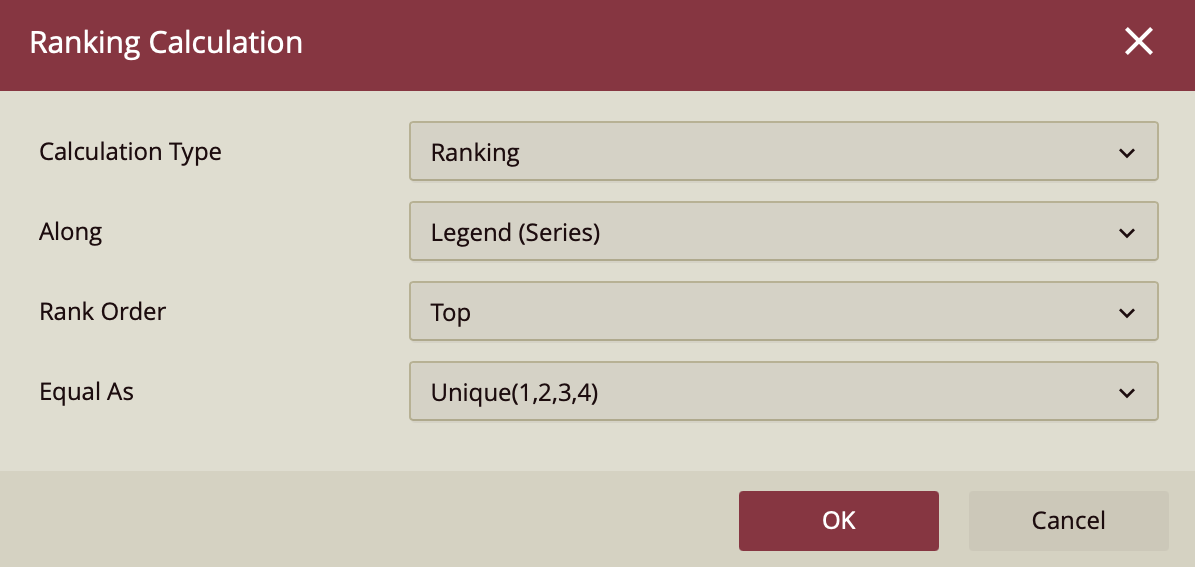
Calculation Type
The Calculation Type is set to Ranking by default. While other calculation types (such as Percentile) are available, they are covered separately. For ranking scenarios, this setting typically remains unchanged.
Along
The Along setting determines the grouping context in which the ranking is applied. This is the most important setting, as it controls how values are compared.
In a simple column chart, all values belong to a single implicit series. Ranking along Legend (Series) applies the calculation across the entire dataset, allowing all categories to be ranked against each other.
Ranking along Axis (Category) in this scenario evaluates each category independently. Since each category contains only a single value, the ranking becomes meaningless and may result in uniform or distorted outputs.
In a grouped column chart, each category contains multiple series values. Ranking along **Axis (Category)**applies the calculation within each category group, allowing values in that group to be ranked independently (for example, ranking quarters within each year).
Additional options, such as Trellis Columns and Trellis Rows, apply when the chart is split into multiple small charts (small multiples). In these cases, ranking is performed independently within each trellis panel.
Rank Order
The Rank Order setting controls whether ranking is assigned from highest to lowest or vice versa:
Top assigns rank 1 to the highest value.
Bottom assigns rank 1 to the lowest value.
Equal As
The Equal As setting determines how ties are handled when multiple values are equal. Each option produces a different ranking pattern:
Unique (1,2,3,4) assigns a distinct rank to every value, even if values are equal.
Competition (1,2,2,4) assigns the same rank to tied values and skips the next rank.
Modified Competition (1,3,3,4) shifts the ranking to account for ties differently, delaying rank progression.
Dense (1,2,2,3) assigns the same rank to ties but does not skip subsequent ranks.
Choosing the appropriate method depends on whether gaps in ranking are acceptable and how ties should be interpreted in the analysis.
Ranking Calculations on a Column Chart
In this example, ranking is applied across the entire dataset to compare countries by sales.
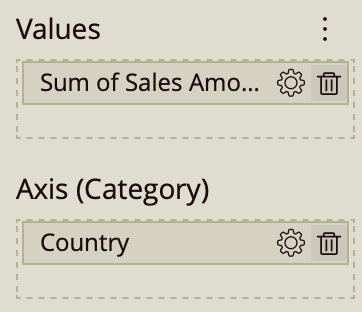
Create a column chart and bind Sales Amount to the Values data binding slot and Country to the Axis (Category).
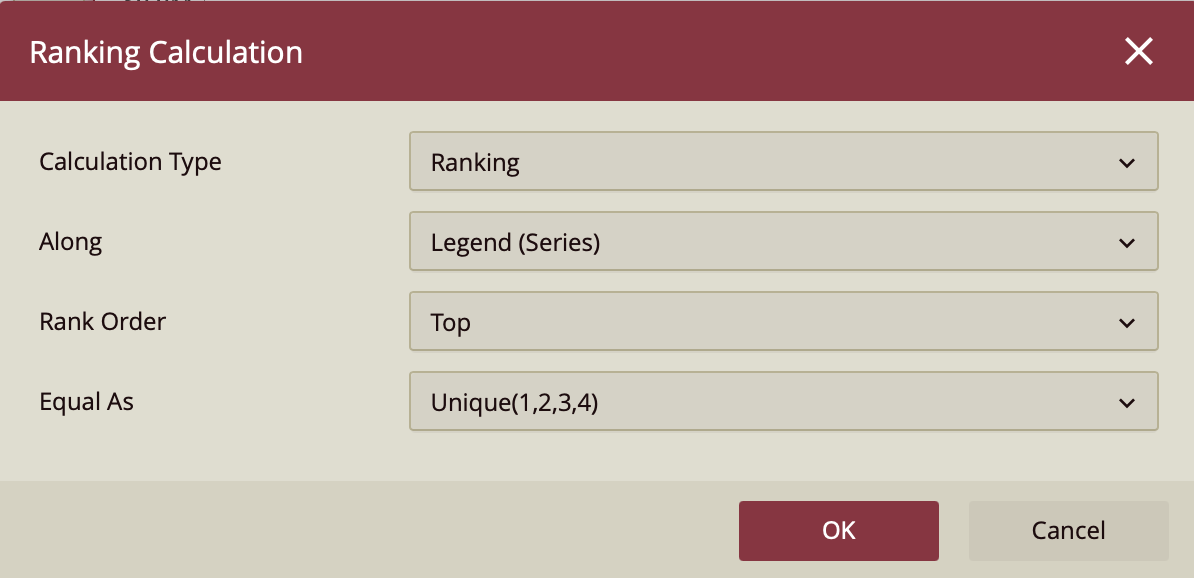
Open the Quick Functions menu for Sales Amount (gear icon) and select Ranking Calculation. Keep the default settings:
Calculation Type: Ranking
Along: Legend (Series)
Rank Order: Top
Equal As: Unique (1,2,3,4)
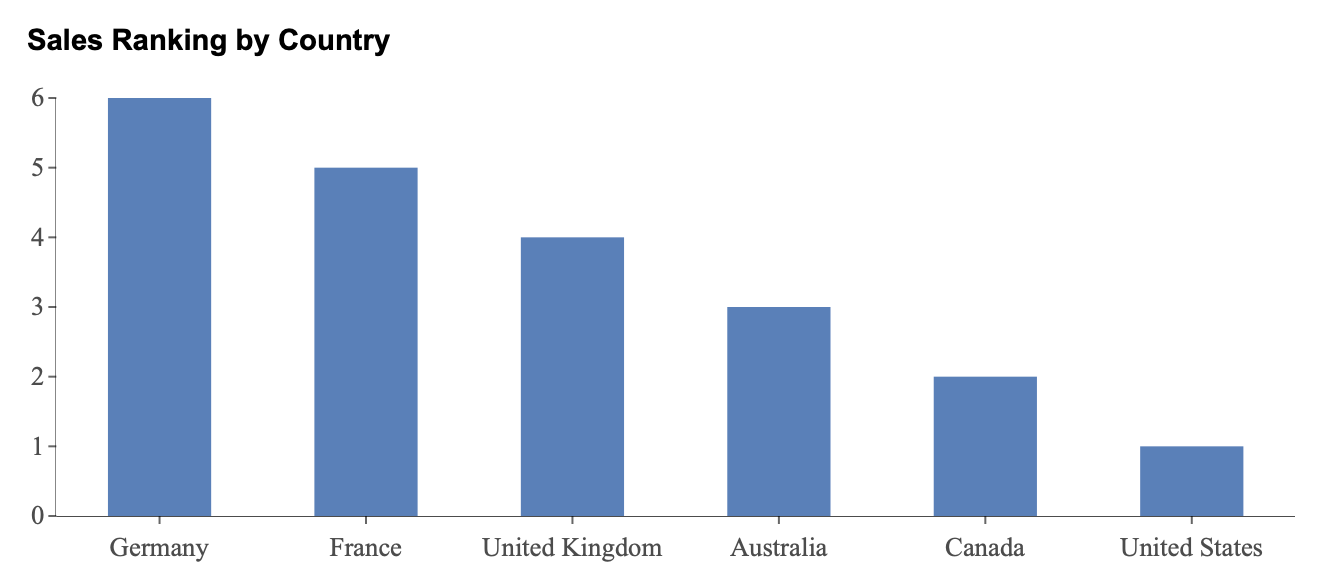
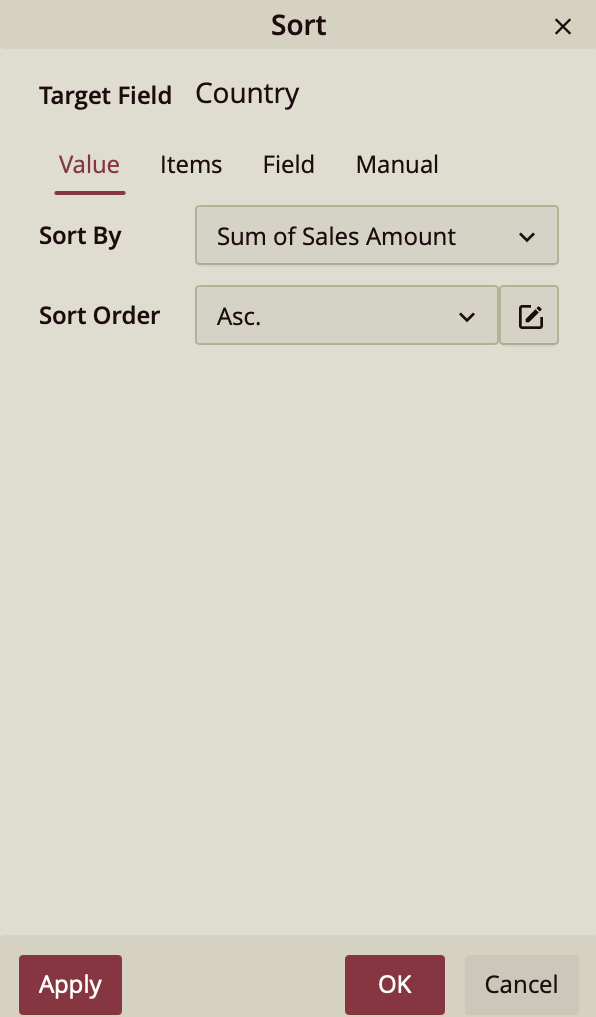
Apply sorting to improve readability. With the chart selected, open the sort options and sort by Sum of Sales Amount in ascending order.
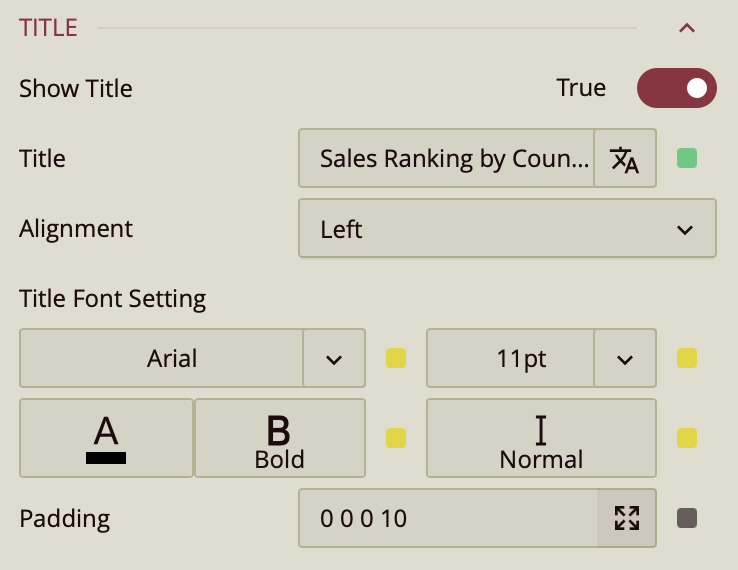
In the Inspector panel, expand the Title section and set the title to Sales Ranking by Country.
In this configuration, ranking is applied globally across all countries. Each column represents the position of a country relative to all others, making it easy to identify top and bottom performers.
Ranking Calculations on a Grouped Column Chart
In this example, ranking is applied within each category group to compare values inside those groups.
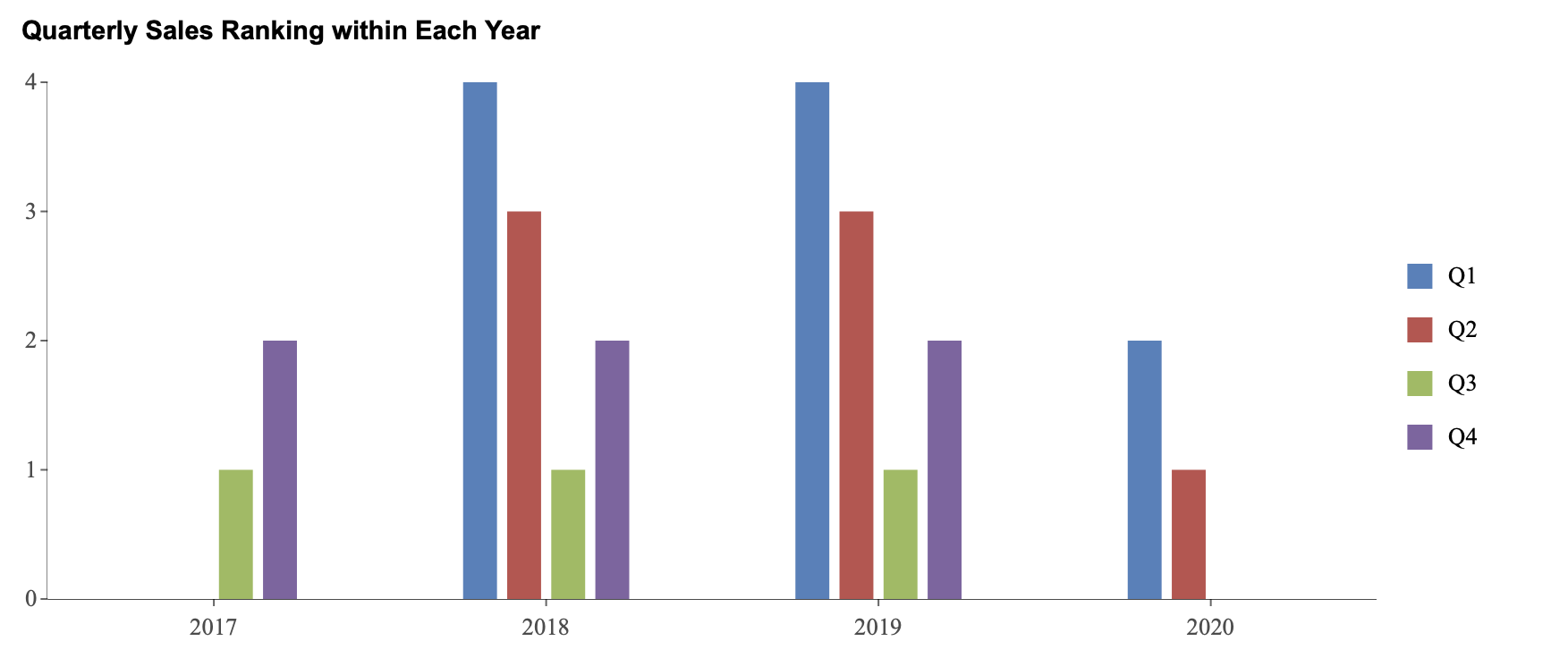
Create a grouped column chart by binding:
Sales Amount to Values
Date (Year) to Axis (Category)
Date (Quarter) to Legend (Series)
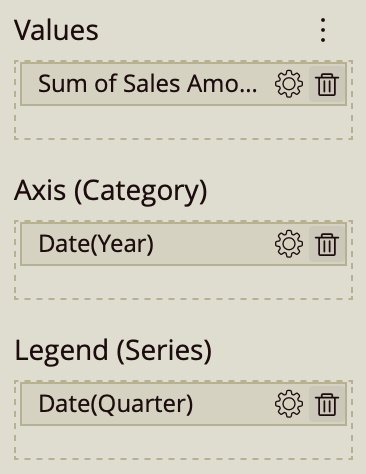
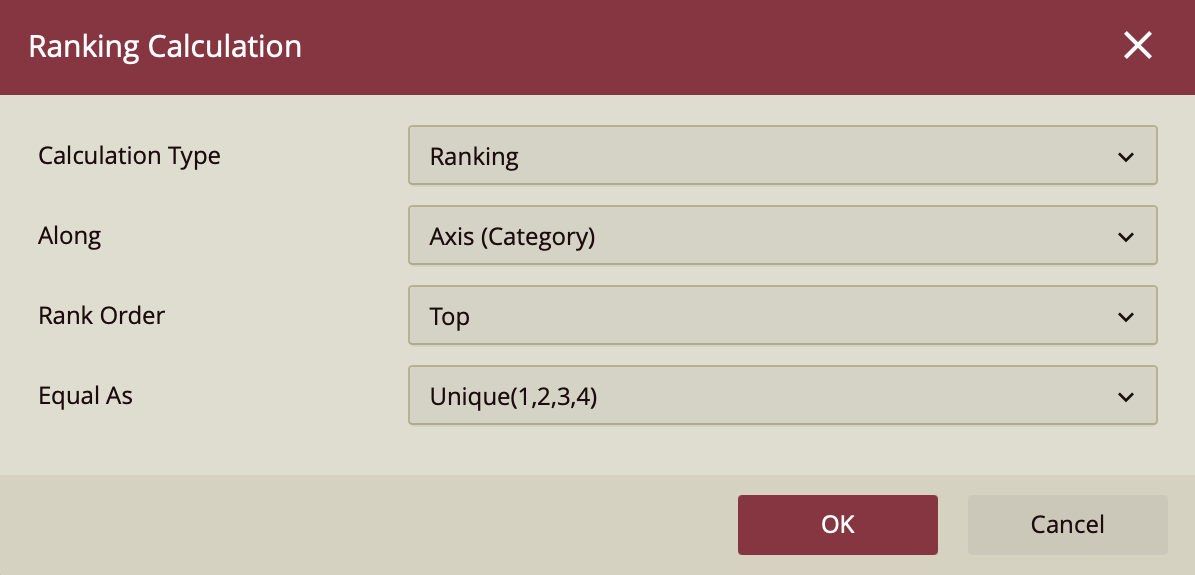
Open the Quick Functions menu for Sales Amount (gear icon) and select Ranking Calculation. Use the following settings:
Calculation Type: Ranking
Along: Axis (Category)
Rank Order: Top
Equal As: Unique (1,2,3,4)
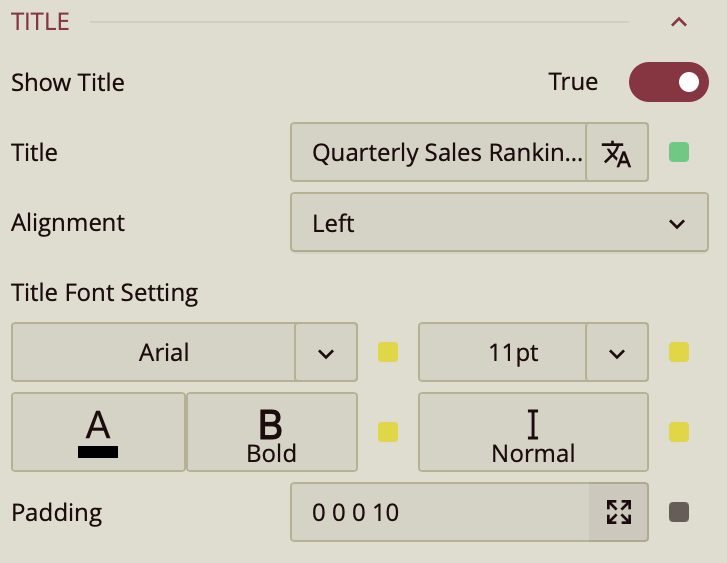
In the Inspector panel, set the chart title to Quarterly Sales Ranking within Each Year.
Here, ranking is scoped to each year independently. Each group (year) contains its own ranked set of quarters, allowing for comparisons within the same category rather than across the entire dataset.