-
Interactive DashboardsCreate interactive BI dashboards with dynamic visuals.
-
End-User BI ReportsCreate and deploy enterprise BI reports for use in any vertical.
-
Wyn AlertsSet up always-on threshold notifications and alerts.
-
Localization SupportChange titles, labels, text explanations, and more.
-
Wyn ArchitectureA lightweight server offers flexible deployment.
-
 Wyn Enterprise 7.1 is ReleasedThis release emphasizes Wyn document embedding and enhanced analytical express...
 -
 Choosing an Embedded BI Solution for SaaS ProvidersAdding BI features to your applications will improve your products, better serve your customers, and more. But where to start? In this guide, we discuss the many options.
-
Visual GalleryInteractive sample dashboards and reports.
-
BlogExplore Wyn, BI trends, and more.
-
WebinarsDiscover live and on-demand webinars.
-
Customer SuccessVisualize operational efficiency and streamline manufacturing processes.
-
Knowledge BaseGet quick answers with articles and guides.
-
VideosVideo tutorials, trends and best practices.
-
WhitepapersDetailed reports on the latest trends in BI.
-
 Choosing an Embedded BI Solution for SaaS ProvidersAdding BI features to your applications will impr...
 -

- Getting Started
- Administration Guide
-
User Guide
- An Introduction to Wyn Enterprise
- Document Portal for End Users
- Data Governance and Modeling
- View and Manage Documents
- Working with Resources
- Working with Reports
-
Working with Dashboards
- Tour the Dashboard Designer
- Create a Dashboard
- Configure Dashboard
-
Dashboard Data Binding
- Data Attributes
- Scenarios
- Appearance
- Component Management
- Parameters
- Interactions
- Finalize Your Dashboard
- Using AI in Wyn
- Working with Notebooks
- Wyn Analytical Expressions
- Section 508 Compliance
- Subscribe to RSS Feed for Wyn Builds Site
- Developer Guide
Running Calculation
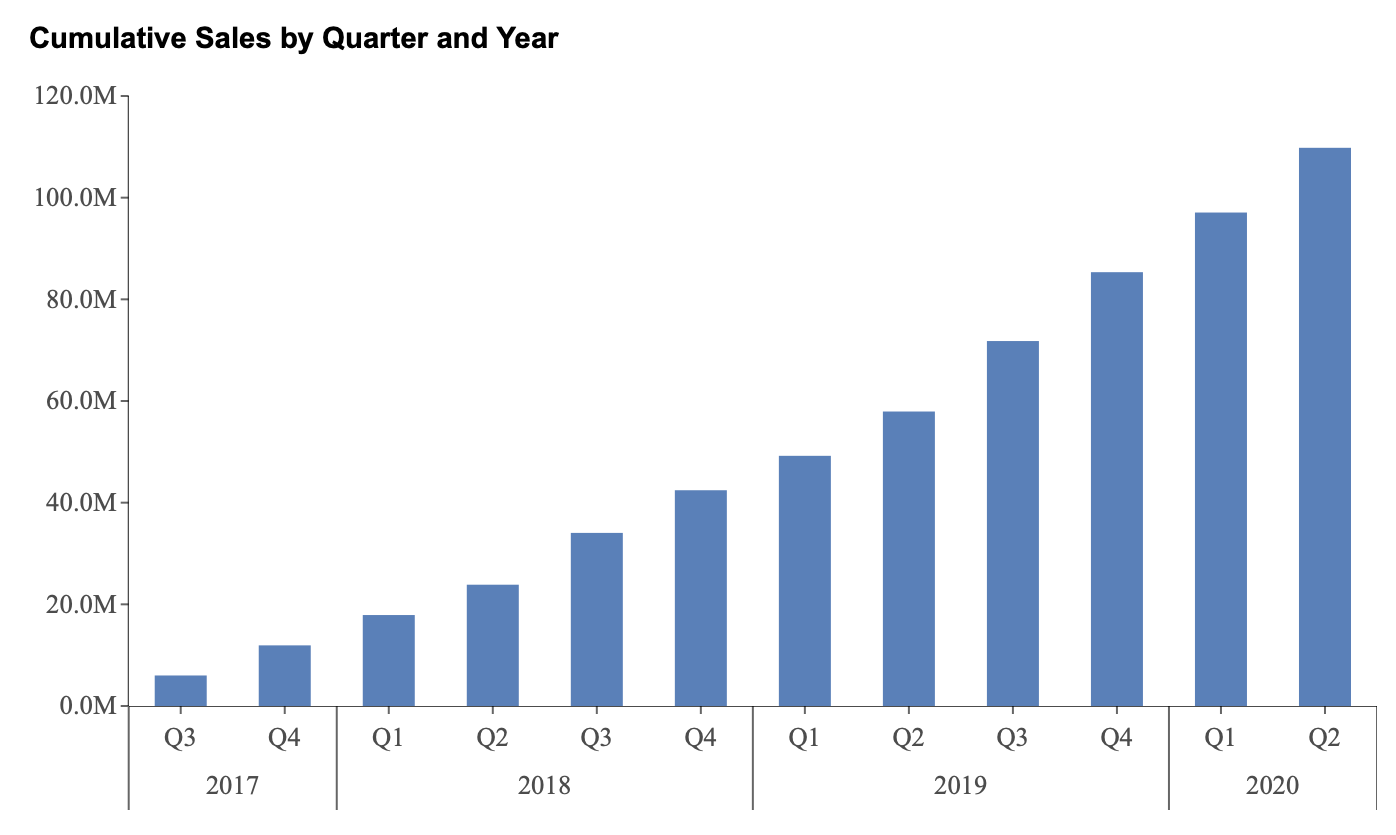
Running calculations apply an accumulation or progressive calculation across a sequence of values. Rather than showing each value independently, the chart displays how the measure changes over time or across categories as values are added together or recalculated step by step.
Running calculations are useful when you want to show trends, cumulative growth, rolling progress, or how a measure evolves across a sequence. For example, a running sum can show how sales accumulate quarter after quarter, while a running average can show how the average changes over time.
In this section, running calculations are demonstrated using a column chart titled Cumulative Sales by Quarter and Year. This example illustrates how running calculations can be used to display progressive sales totals across a hierarchical time sequence.
Applying a running calculation fundamentally changes how the chart is interpreted. The value axis no longer represents only the value for an individual category. Instead, it represents the accumulated or recalculated value up to that point in the sequence. As a result, column heights reflect progression over time rather than isolated values.
Understanding Running Calculation Settings
When you select Running Calculation from the Quick Functions menu, a configuration panel appears with settings that determine how the running calculation is applied.
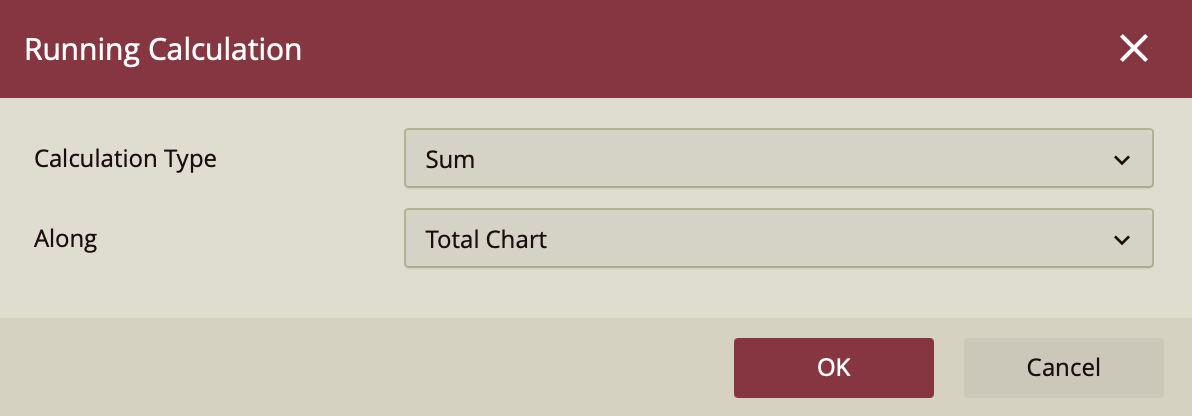
Calculation Type
The Calculation Type setting determines which running operation is used.
Sum progressively adds values together.
Average recalculates the average as each new value is included.
Max displays the highest value reached up to that point.
Min displays the lowest value reached up to that point.
Count displays the running number of values included so far.
The selected calculation type determines how the running sequence evolves from one category to the next.
Along
The Along setting determines the scope in which the running calculation is applied.
Total Chart applies the running calculation across the entire chart sequence.
Trellis Row applies the running calculation independently within each trellis row.
Trellis Column applies the running calculation independently within each trellis column.
Trellis Cell applies the running calculation independently within each individual trellis panel when both trellis rows and trellis columns are present.
When a chart uses both trellis rows and trellis columns, the result is a grid of smaller charts. In that scenario, Trellis Cell limits the running calculation to each individual chart in the grid, while Trellis Row and Trellis Column extend the running calculation across multiple charts in the same row or column.
Running Calculations on a Column Chart
In this example, a running calculation is applied across the entire dataset to show cumulative sales over time.
Create a column chart and bind Sales Amount to the Values data binding slot.
Bind Date (Year) and Date (Quarter) to the Axis (Category) data binding slot, in that order, to create a hierarchical time sequence.
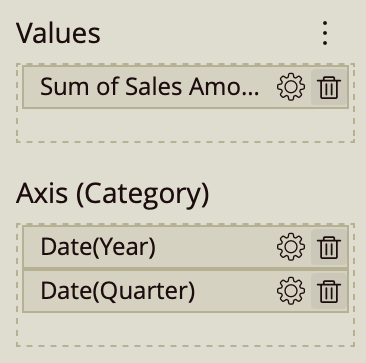
Open the Quick Functions menu for Sales Amount (gear icon) and select Running Calculation.
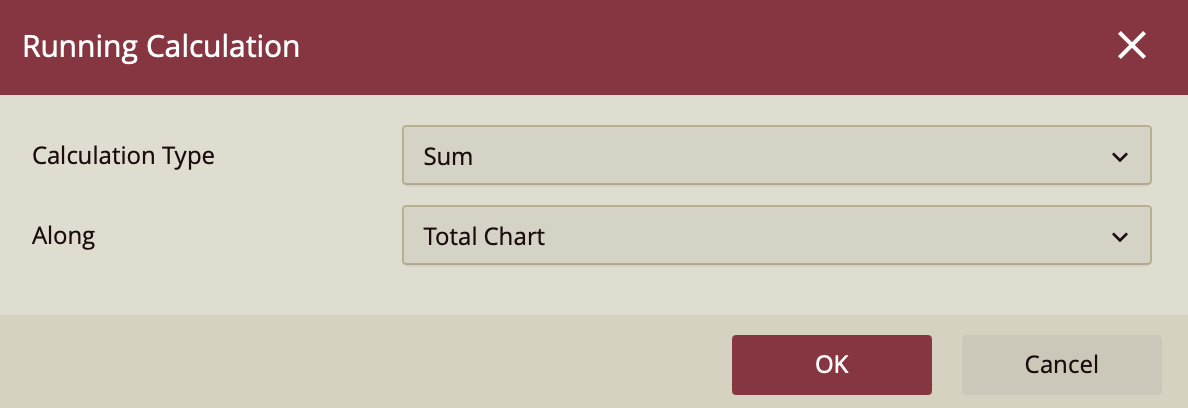
Use the default settings:
Calculation Type: Sum
Along: Total Chart
In the Inspector panel, expand the Title section and set the title to Cumulative Sales by Quarter and Year.
In this configuration, the running calculation is applied across all quarters in sequence. Each column represents the cumulative total up to that point, rather than the sales amount for a single quarter. As the chart progresses, the column heights continue to grow, making it easy to see how sales accumulate over time.