-
Interactive DashboardsCreate interactive BI dashboards with dynamic visuals.
-
End-User BI ReportsCreate and deploy enterprise BI reports for use in any vertical.
-
Wyn AlertsSet up always-on threshold notifications and alerts.
-
Localization SupportChange titles, labels, text explanations, and more.
-
Wyn ArchitectureA lightweight server offers flexible deployment.
-
 Wyn Enterprise 7.1 is ReleasedThis release emphasizes Wyn document embedding and enhanced analytical express...
 -
 Choosing an Embedded BI Solution for SaaS ProvidersAdding BI features to your applications will improve your products, better serve your customers, and more. But where to start? In this guide, we discuss the many options.
-
Visual GalleryInteractive sample dashboards and reports.
-
BlogExplore Wyn, BI trends, and more.
-
WebinarsDiscover live and on-demand webinars.
-
Customer SuccessVisualize operational efficiency and streamline manufacturing processes.
-
Knowledge BaseGet quick answers with articles and guides.
-
VideosVideo tutorials, trends and best practices.
-
WhitepapersDetailed reports on the latest trends in BI.
-
 Choosing an Embedded BI Solution for SaaS ProvidersAdding BI features to your applications will impr...
 -

- Getting Started
- Administration Guide
-
User Guide
- An Introduction to Wyn Enterprise
- Document Portal for End Users
- Data Governance and Modeling
- View and Manage Documents
- Working with Resources
- Working with Reports
- Working with Dashboards
-
Working with Notebooks
- Notebook Designer
- Connect to Data
-
Blocks
- Content Blocks
- List Blocks
- Quote Blocks
- Structure Blocks
- Table Blocks
- Chart Blocks
- KPI
- Label Slicer
- Map
-
Property Reference
- Common Properties
- Stacked Column Chart Properties
- Percent Stacked Column Chart Properties
- Bar Chart Properties
- Stacked Bar Chart Properties
- Percent Stacked Bar Chart Properties
- Line Chart Properties
- Area Chart Properties
- Stacked Area Chart Properties
- Percent Stacked Area Properties
- Combined Chart Properties
- Pie Chart Properties
- Donut Chart Properties
- Scatter Chart Properties
- Bubble Chart Properties
- Funnel Chart Properties
- Treemap Chart Properties
- KPI Chart Properties
- Pivot Table Properties
- Data Table Properties
- KPI Matrix Properties
- Label Slicer Properties
- Map Properties
- Wyn Analytical Expressions
- Section 508 Compliance
- Subscribe to RSS Feed for Wyn Builds Site
- Developer Guide
Scatter Chart Properties
Data Binding
The Data Binding tab allows you to configure the data fields used in the scatter plot.
X Axis – Drag a numeric or categorical field here to define the position of points along the horizontal axis.
Y Axis – Drag a numeric field here to define the position of points along the vertical axis.
Legend (Series) – Drag a categorical field here to group points into series, which are distinguished by color or symbol.
Trellis Columns – Drag a categorical field here to create a column-based small multiple layout. Each column displays a subset of the data based on the field value.
Trellis Rows – Drag a categorical field here to create a row-based small multiple layout. Each row displays a subset of the data based on the field value.
Tooltip – Drag one or more fields here to display additional information when a user hovers over a point in the scatter plot.
Chart Style
Scatter charts in Wyn can be extensively styled and configured using the Inspector panel. Below are key settings you can modify:
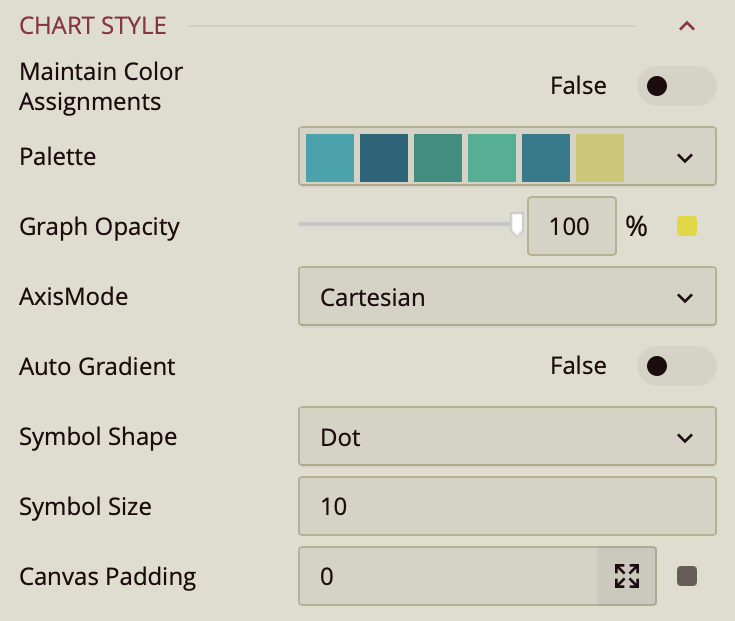
Maintain Color Assignments: Toggle this to True if you want to manually assign specific colors to individual data values instead of using automatic color mapping.
Palette: Lets you customize the color scheme applied to the chart. Use the dropdown to choose from available color palettes based on the current Theme.
Graph Opacity: Controls the transparency of the chart. Set to 0% for fully transparent or 100%for fully opaque.
Axis Mode – Determines how the chart axes are displayed:
Cartesian (default) – Standard X and Y coordinate axes.
Radial – Axes radiate out from a central point.
Polygonal – Axes form a polygon shape for data plotting.
Auto Gradient – A toggle option that, when enabled, automatically applies a gradient color effect to the plotted symbols. Default is false.
Symbol Shape – Specifies the shape used for data points:
Dot (default) – Standard circular marker.
Box – Square marker.
Triangle – Equilateral triangle marker.
Diamond – Diamond-shaped marker.
Plus – Plus sign marker.
X – Cross-shaped marker.
Symbol Size – Defines the size of the data point symbols. Accepts a numerical value.
Canvas Padding – Controls the amount of blank space between the plotted data area and the edges of the chart canvas. Accepts a numerical value.
Data Visualization
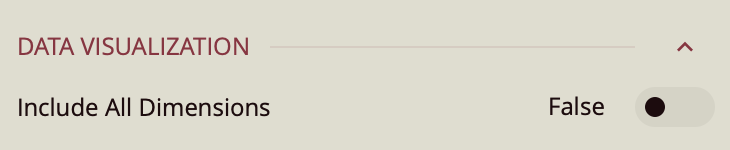
Include All Dimensions – When enabled, ensures that all available dimension values are included in the visualization, even if they have no corresponding measure values. This can help maintain consistent category representation across views. Default: Off.
Tooltip
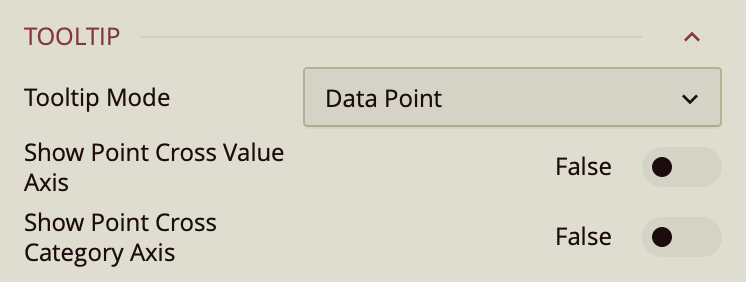
Tooltip Mode – Determines how tooltips are displayed when hovering over the chart:
None – Disables tooltips.
Data Point (default) – Shows a tooltip for the specific data point under the pointer.
Category – Shows a tooltip for all data points that share the same category value.
Show Point Cross Value Axis – Draws a line from the hovered point to the value axis, making it easy to identify the exact value.
Show Point Cross Category Axis – Draws a line from the hovered point to the category axis, making it easy to identify the exact category.
X-Axis
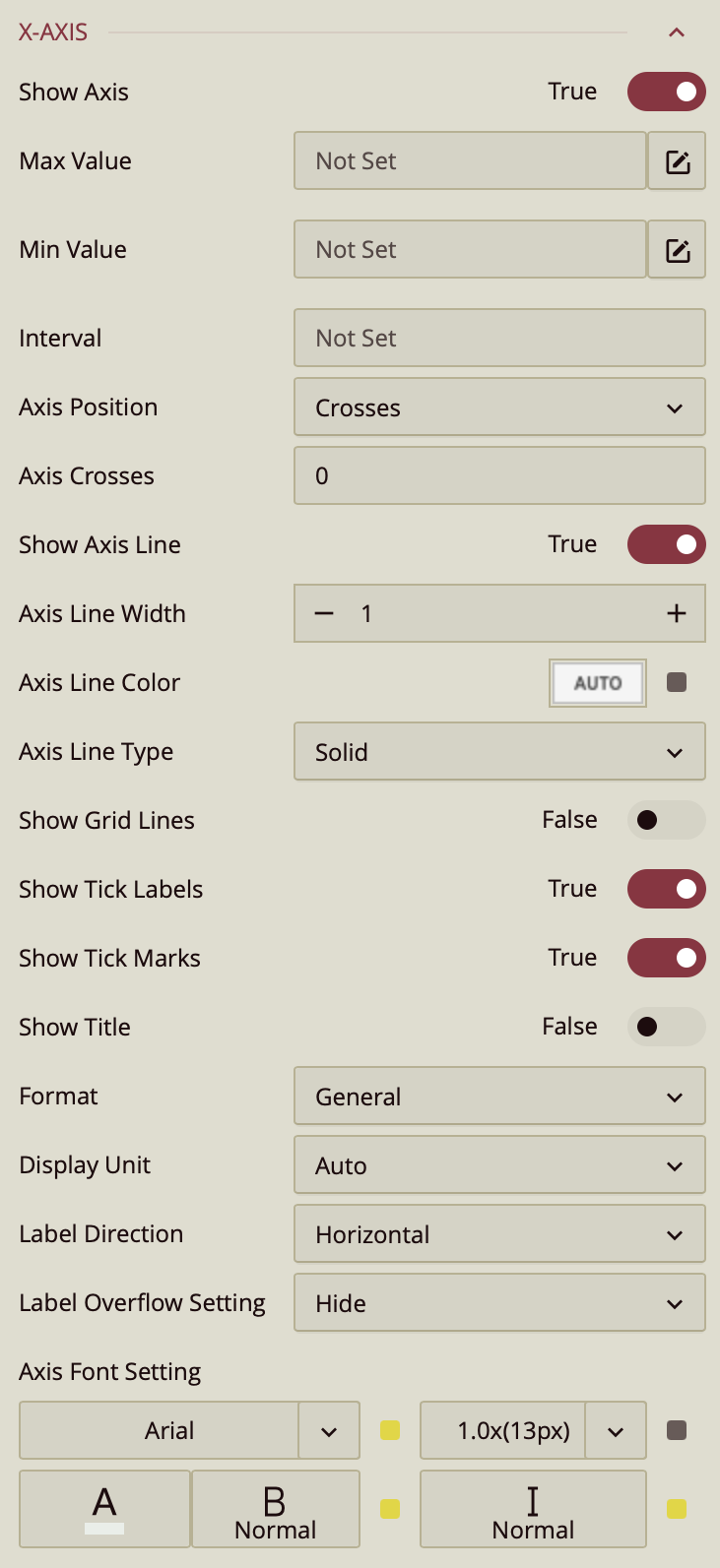
Show Axis – Toggles the visibility of the X-axis. Default is On.
Max Value / Min Value – Define the numeric upper and lower bounds for the axis scale. Leaving these blank allows the chart to automatically determine the range based on the data.
Interval – Sets the spacing between axis tick marks. If left blank, the chart automatically calculates an appropriate interval.
Axis Position – Determines the placement of the X-axis relative to the chart area. Options:
Crosses (default) – Positions the axis at the crossing point defined by Axis Crosses.
Bottom – Places the axis along the bottom edge of the chart.
Top – Places the axis along the top edge of the chart.
Axis Crosses – Numeric value indicating the point on the opposite axis where this axis intersects.
Show Axis Line – Toggles the visibility of the axis baseline. Default is On.
Axis Line Width / Color / Type – Control the thickness, color, and style (solid or dashed) of the axis line.
Show Grid Lines – Toggles horizontal grid lines extending from axis tick marks into the chart. Default is Off.
Show Tick Labels – Toggles the display of numeric or category labels along the axis.
Show Tick Marks – Toggles small marks indicating individual axis intervals.
Show Title – Toggles the display of an axis title. Default is Off.
Format – Determines how axis values are displayed: General (default), Number, Currency, Percentage, or Custom.
Display Unit – Scales displayed values to a chosen unit: Auto (default), None, Thousands, Millions, Billions, Trillions.
Label Direction – Sets the orientation of axis labels: Horizontal (default), Vertical, Diagonal.
Label Overflow Setting – Defines how overflowing labels are handled: Hide (default), Ellipsis, Wrap.
Axis Font Setting – Controls the font family, size, color, weight, and style for axis labels.
Y-Axis
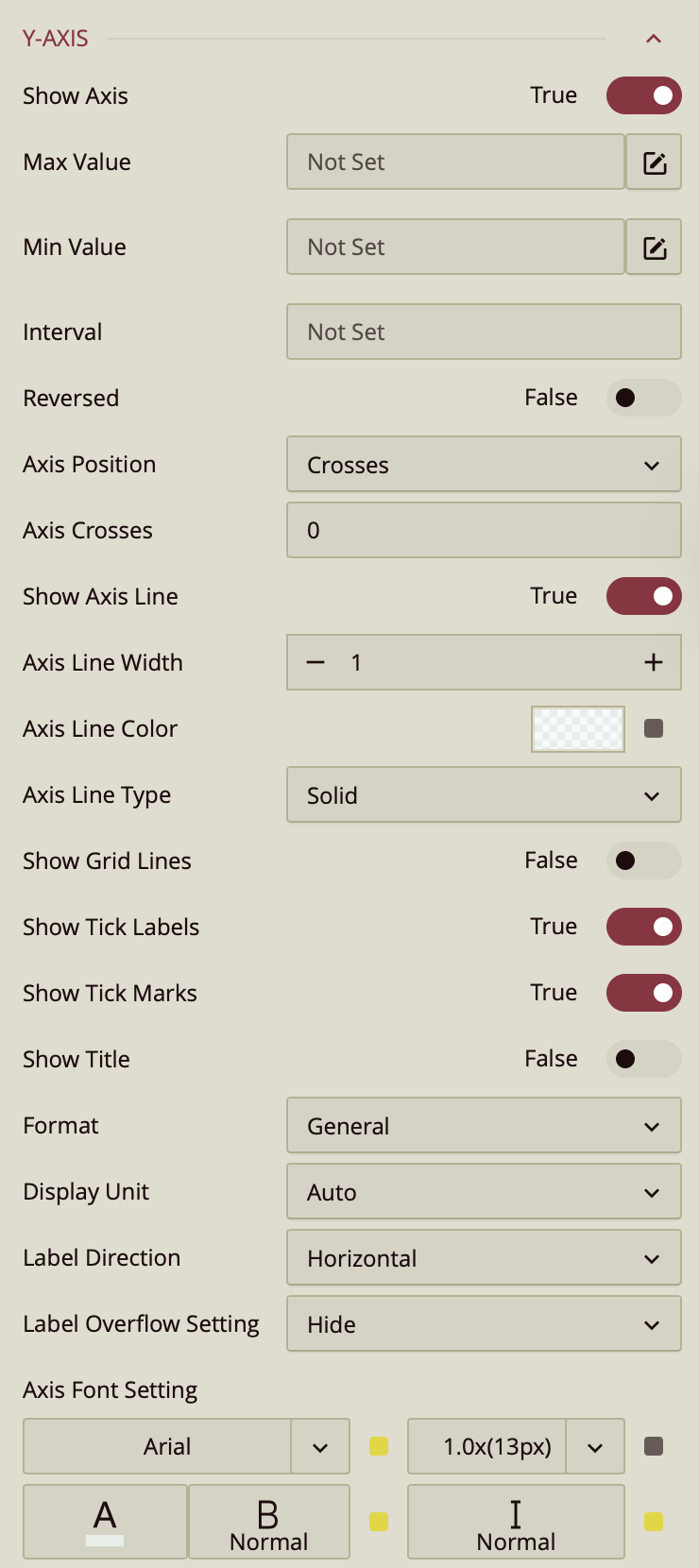
Show Axis – Toggles the visibility of the X-axis. Default is On.
Max Value / Min Value – Define the numeric upper and lower bounds for the axis scale. Leaving these blank allows the chart to automatically determine the range based on the data.
Interval – Sets the spacing between axis tick marks. If left blank, the chart automatically calculates an appropriate interval.
Axis Position – Determines the placement of the X-axis relative to the chart area. Options:
Crosses (default) – Positions the axis at the crossing point defined by Axis Crosses.
Bottom – Places the axis along the bottom edge of the chart.
Top – Places the axis along the top edge of the chart.
Axis Crosses – Numeric value indicating the point on the opposite axis where this axis intersects.
Show Axis Line – Toggles the visibility of the axis baseline. Default is On.
Axis Line Width / Color / Type – Control the thickness, color, and style (solid or dashed) of the axis line.
Show Grid Lines – Toggles horizontal grid lines extending from axis tick marks into the chart. Default is Off.
Show Tick Labels – Toggles the display of numeric or category labels along the axis.
Show Tick Marks – Toggles small marks indicating individual axis intervals.
Show Title – Toggles the display of an axis title. Default is Off.
Format – Determines how axis values are displayed: General (default), Number, Currency, Percentage, or Custom.
Display Unit – Scales displayed values to a chosen unit: Auto (default), None, Thousands, Millions, Billions, Trillions.
Label Direction – Sets the orientation of axis labels: Horizontal (default), Vertical, Diagonal.
Label Overflow Setting – Defines how overflowing labels are handled: Hide (default), Ellipsis, Wrap.
Axis Font Setting – Controls the font family, size, color, weight, and style for axis labels.
Legend

By default, the Show Legend toggle is set to False. To include a title for the legend, enable the Title toggle as well. You can customize the title by setting the Font Family (e.g., Arial), Font Size, Text Color, Font Weight (such as bold), and applying Italic styling if desired.
The Position property allows you to position the legend title to the left, center, or right of the chart area.
The legend is set to Auto Size by default. To manually define the legend size, disable this setting by setting Auto Sizeto False. You can also control the Horizontal and Vertical Alignment, which are both set to Auto by default but can be changed using dropdown options. To allow legend labels to wrap across lines, set the Wrap Legend option to True.
Click Action ??
Trellis
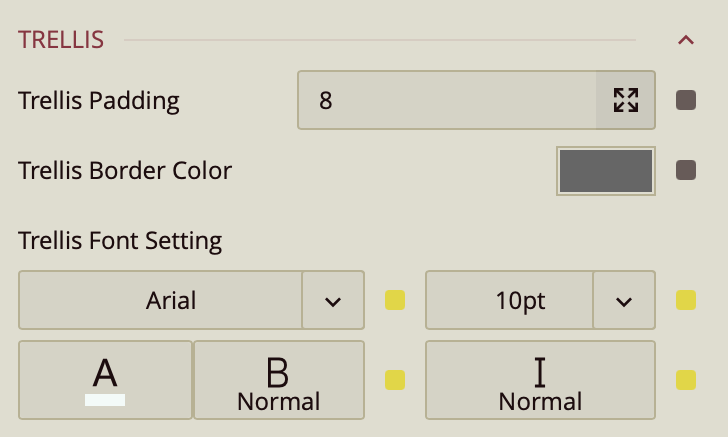
Use the Trellis properties when you create a Trellis Chart. This can be done in the Data Binding Tab. Drag and drop the attribute to Trellis.
You can set the Padding around the Trellis Chart to control the spacing between the chart content and its edges. You can also define a Trellis Border Color to outline each panel of the trellis. Additionally, the Trellis Font Settings allow you to customize the font family, size, color, weight, and style of the text used in the trellis layout.